News and Views
Investing in Spay/Neuter
Taos Feral Feline Friends (TFFF) began as a non-profit cat shelter in 2004. The first residents at our shelter were cats scheduled for euthanasia that I rescued from the community shelter. When our facility quickly reached capacity, I realized that animal shelters alone could not adequately protect animals or the community from overpopulation.
I became a spay/neuter advocate. TFFF began offering free spay/neuter for pet cat adoptions and free Trap, Neuter and Return (TNR) for feral cats. In 2023, we formed a Spay/Neuter Services division and founded a veterinary clinic providing free spay/neuter for all cats and dogs in Taos County.
However, in many communities across New Mexico, there is little or no access to affordable spay/neuter. Commercial veterinary clinics charge hundreds of dollars for each spay/neuter and compound that with vaccination charges. Many households cannot afford such expenses even for just one animal, much less for an entire litter. The result: unwanted litters of animals thrust into the community, each requiring a lifetime of care, an expensive long-term obligation. The cost of this care diminishes community financial resources for vital human needs: education, child care, health care, starting or growing a business, etc.
This report is intended to offer a simple, factual financial rationale for investing in spay/neuter. It is designed for lawmakers, executive decision-makers and business persons who are not committed animal advocates, who view potential spay/neuter investments as competing with funding for many other community priorities. Nonetheless, I hope it will also enlighten animal welfare workers and volunteers by offering them an unemotional argument to supplement their discussions with spay/neuter donors and funders.
The NM Affordable Spay/Neuter Act, effective in 2020 but expiring July 1, 2026, is a critical source of spay/neuter funding in New Mexico, supporting dozens of programs across the state. We urge the NM legislature to renew the legislation. We also encourage NM county and municipal government leaders to expand their investment in spay/neuter.
I think you’ll be surprised how the numbers turned out! Investing in spay/neuter is more than good animal welfare... it’s a fantastic investment in human welfare.
Leanne Mitchell, President and Founder
February 11, 2026
BACKGROUND
Cat/dog overpopulation is a serious problem throughout New Mexico. Safety protocols during the COVID-19 pandemic forced local veterinary clinics to slash available appointments. People often just chose to stay home during the pandemic. Cat/dog spay/neuter was deferred, unintentionally triggering litter after litter of excess births, many of which became homeless strays. In Taos County, the community animal shelter was so overwhelmed they non-renewed their town and county contracts and ultimately closed their doors. No community shelter served Taos for over two years.
Increased funding for spay/neuter is the only investment that can humanely and effectively address cat/dog overpopulation and prevent disastrous outcomes such as shelter closures.
OVERVIEW
This report will determine the investment return expected from paying for spay/neuter surgery (the investment) and achieving a reduction in future animal care expenses (the payback). In this construct, the investor is a donor, grantor, business or government-entity providing the money and the payback is earned by the community in which the service occurs. Note that it doesn’t matter whether a new litter is retained by the owner, adopted out to others in the community or abandoned to an animal shelter – the community-wide costs of care for the litter are unaffected.
The analysis does not attempt to prescribe an economic value to the lives of cats and dogs. It does not estimate the economic benefit that a guard or guide dog provides, nor the emotional benefits derived from pet ownership. The former only occurs in a minority of situations and the latter is intangible. It also does not estimate the additional community costs resulting from cat/dog overpopulation such as increased animal bite injuries, increased needs for animal control personnel and equipment and increased demands for constructing or expanding animal shelter facilities. To summarize, the analysis focuses strictly on the direct cost of spay/neuter vs. the direct cost of future animal care.
The analysis requires several assumptions. Each assumption is based upon credible public and private data sources. Each selected assumption has been explicitly adjusted to guarantee that the computations produce results well below realistic expectations. Following the summary of results, the sources and rationale for each assumption will be discussed.
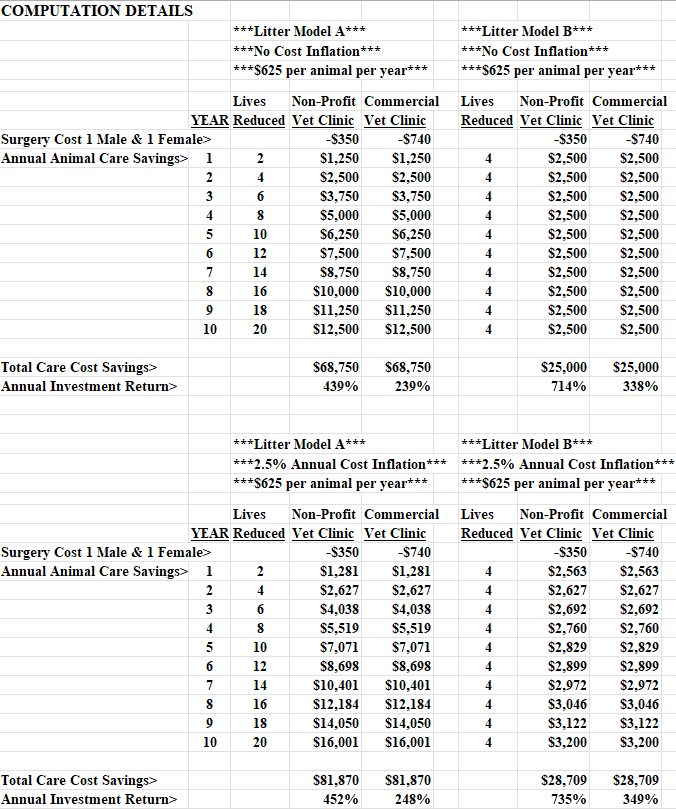
The computations are based on the cost of providing two surgeries: one male and one female cat or dog. However, for determining the reduction in births, only the female spay is considered. Ignoring the impact of male neuter is an example of biasing the returns lower.
The annual rates of return are determined for a few different scenarios: spay/neuter performed at a lower cost non-profit clinic vs. a commercial clinic, animal care costs with no inflation vs. 2.5% annual inflation and two alternate models of reproduction: Litter Model A and Litter Model B.
SUMMARY OF RESULTS
Spay/Neuter at a Non-Profit Clinic Minimum Return: 439% per year Spay/Neuter at a Commercial Clinic Minimum Return: 239% per year
DISCUSSION OF ASSUMPTIONS
Spay/Neuter Surgery Costs: For 1 male plus 1 female surgery, the computations assume $350 for non-profit vs. $740 for commercial clinics.
Sources: The TFFF clinic in El Prado averaged about $150 per surgery in 2024. $175 per animal is assumed herein. According to a recent report on the Vety.com website, commercial clinic spay/neuter charges range from $200 to $400 for male cats, from $300 to $500 for female cats, The average midpoint cost for 1 male and 1 female is $700. Dogs range from $200 to $500 for males and from $250 to $650 for females. The average midpoint cost for 1 male and 1 female is $800. Based on TFFF clinic data, approximately 60% of the surgeries were cat; 40% dog. Reflecting these weights, the average commercial costs of spay/neuter for 1 male and 1 female is $740.
Annual Cost of Animal Care: $625 per animal
Sources: According to Rover.com, “the world’s largest online marketplace for loving pet care”, a survey of 1000 pet owners in 2025 for its sixth annual True Cost of Pet Parenthood Report. They report a range of $1150 to $4420 annually for dogs and $750 to $2750 annually for cats. This includes food, shelter, toys, cat litter, vet visits and boarding. Assume the bottom end of each range and that feral cats only require 50% of the cat bottom value. Then, the average annual care cost per animal is $865 (40% of $1150 for dogs plus 48% of $750 for pet cats plus 12% of $375 for feral cats; weights are from the inception-to-date animal distribution of the TFFF clinic). However, the cost of living in NM is roughly 8% below the national average, reducing the estimated annual cost for New Mexico to $795 per year. To provide a further safety margin, only $625 per animal per year is assumed.
Lifespan: 10 years lifespan
Sources: According to Montoya et al., published in the journal, Frontiers in Veterinary Science, dogs live on average from 6.7 to 15.5 years, depending on breed. The midpoint average is 11.1 years. Cats live 12.3 to 16.9 years with the midpoint average being 14.6 years. Per TFFF estimates, feral cats live about three years. Based on 80% pets and 20% ferals, the average cat lifespan is 12.2 years. To ensure an understatement, only 10 years average life is assumed and no benefit of spay/neuter beyond ten years is considered.
Reproduction:
Litter Model A supposes that each female spay prevents a single litter consisting of one male and one viable female and each newborn female produces just one identical litter of one male and one female. Litter Model B supposes that each female spay eliminates exactly one litter of four with no consideration of further litters created by the original animal or its offspring. Both models assume both a male and female are sterilized. Both models ignore any potential reduction in future births due to the male neuter.
Sources: Per VCA and Banfield Hospital clinical studies, average litter size is 5.3 for dogs and 5.0 for cats. Adjusted for infant deaths, the surviving litter size is 4.5 for dogs and 3.9 for cats. Using a 60% cat/40% dog assumption, the average surviving litter size is 4.1. Cats can produce three litters each year; dogs can produce two. To provide a margin of safety, only one litter per year is assumed herein. In Model A, litter size is 2 and each female can only produce one litter. In Model B, litter size is 4 but no additional litters are assumed.
CONCLUSIONS
Annual returns of 439% for non-profit spay/neuter and 239% for commercial spay/neuter understate the actual financial benefits of spay/neuter due to the use of minimizing assumptions throughout the computations.
Spay/neuter produces large returns regardless of whether performed at a non-profit or commercial clinic. Voucher programs, in which a commercial clinic is paid by a third party, can be confidently used in localities that do not have a non-profit clinic.
Spay/neuter produces large returns even assuming no inflation in animal care costs.
Due to the huge investment returns, spay/neuter programs that offer the broadest access to spay/neuter are preferred over those limiting access. For example, free programs are preferred over co-pay programs. Programs without income qualifications are preferred over those with limits. Programs that offer consistent hours/days of operation are preferred over sporadic ‘visiting veterinarian’ programs.
Feral cat reproduction, if left unchecked, can negate the benefits of pet cat spay/neuter. Trap, Neuter and Return (TNR) for feral cats is universally regarded as the best humane treatment for feral cats. Since trapping usually requires the cooperation of non-owner volunteers, spay/neuter programs should facilitate TNR by lending out traps for free and offering walk-in appointments.
Instead of financial benefits, animal shelters primarily offer their communities humane benefits. Effective spay/neuter programs lower shelter intakes. Shelter costs and overcrowding decline and better humane outcomes result. In the present crisis of cat/dog over-population, spay/neuter funding should be emphasized over shelter funding.
Taos Feral Feline Friends (TFFF) Urges Legislative Action to Save New Mexico’s Affordable Spay/Neuter Law
Taos, NM 12/1/2025
Since 2020, the Affordable Spay/Neuter Law has collected over $5 million from pet food manufacturers to provide NM organizations with much-needed funding to address the cat/dog over-population crisis destabilizing animal welfare across the state. So far this year, NM animal welfare providers have received $1 million to fund spay/neuter in their communities. Unfortunately, the law is due to expire on July 1, 2026, unless the NM legislature takes action.
According to Judy Wolf, Chief Program & Policy Officer for Humane Communities at Animal Protection New Mexico (APNM) and Animal Protection Voters (APV), “Access to affordable spay/neuter is a basic community service that New Mexicans need and deserve, especially in rural, Tribal and low-income areas. Funds from the Affordable Spay/Neuter Law allow communities to expand their spay/neuter efforts or create free clinics like TFFF did with the outstanding El Prado spay/neuter clinic that benefits everyone in Taos County.”
Leanne Mitchell, President of Taos Feral Feline Friends, commented “From 2005, when we introduced Trap, Neuter and Return in Taos County, to 2024 when we created the El Prado veterinary clinic, TFFF has championed spay/neuter as the foundation upon which all animal welfare rests. The efforts of APV have been critical in elevating the spay/neuter agenda to the state level, successfully working with legislators to pass the Affordable Spay/Neuter Law and help many organizations address over-population.”
Judy Wolf continued, “TFFF worked with us on NM House Bill 113, the Animal Welfare Program Fund, signed into law in 2025, providing a further $5.0 million in animal welfare funding to NM charities. TFFF’s advocacy was instrumental in ensuring that these funds would be available for spay/neuter. Today, we are pleased to have their support in the fight to keep the Affordable Spay/Neuter Law alive.”
In conclusion, Leanne Mitchell, emphasized, “We confirm full support to Judy Wolf and the staff of APV. Our state is truly fortunate to have their effective, determined advocacy for animal welfare. The over-population crisis is not just a Taos problem; it’s a statewide issue. New Mexico needs the Affordable Spay/Neuter Law, but unless the state acts soon, it ends. Please call or write your NM state representative and state senator and tell them to support APV’s efforts to keep spay/neuter funds flowing.”
For more information about the Affordable Spay/Neuter Law or Animal Protection New Mexico and Animal Protection Voters, please contact Judy Wolf (judy@apnm.org/505-280-9062).
For more information about Taos Feral Feline Friends or animal welfare in Taos County, please contact Leanne Mitchell (catmomoftaos@hotmail.com/575-758-3519).
A $100 Million Spay/Neuter Clinic
Taos, NM 11/8/2025
Donna Karr of Spay Taos recently announced that the spay/neuter clinic has surpassed 4000 successful spay/neuter surgeries, counting both the TFFF and Spay Taos activity. This activity level is roughly 250 per month/3000 per year, a rate of free spay/neuter in Taos County that exceeds by 50% the free spay/neuter rate from any past year, a rate that is sufficient to lower cat/dog population in the community. Considerable progress towards that goal has already been achieved.
At 4000 cases, assuming an average commercial vet clinic bill for spay/neuter and vaccinations of $350 per animal, the immediate out-of-pocket savings in veterinary costs is $1.4 million. These cost savings are shared by each client who used the free clinic instead of a commercial vet clinic.
However, that savings is just a tiny fraction of the total economic benefit of 4000 spay/neuter cases. Every time a cat or dog receives spay/neuter, its reproductive potential is completely and permanently eliminated. Hence, every time a cat or dog receives spay/neuter, the community is spared the expense of life-time care for each of the animal’s potential offspring. The burden of this care may not fall on the owner of the animal. If the owner finds new homes for each animal born, the burden shifts to the new owner. If the offspring are abandoned, the burden shifts to whatever shelter, rescue or kind soul that ultimately adopts them.
We will estimate the economic value of removing 4000 cats and dogs from the reproductive population. In order to do so, some assumptions are necessary. All assumptions are intentionally designed to understate the economic value.
The first assumption is the number of offspring prevented by each spay/neuter. There are various charts that look like ‘pyramids’, demonstrating how one unspayed female will create a first generation of newborns, who in turn, after six months, produce a second generation of new offspring, on and on and on… In these charts, all females of all generations, including the original mom, keep birthing every six months. Such exercises typically project thousands of extra animals born over three or four years, all a result of just one original unspayed female.
Let’s flatten the pyramid. An unspayed female is highly likely to have at least one litter over its unspayed life. An unneutered male is highly likely to sire at least one litter over its unneutered life. We will assume that spay/neuter of each animal, male or female, prevents just one litter of four kittens or puppies, and ignore the reality that the original mom and her newborn females are highly likely to have a number of additional litters over time. In other words, assume no ‘pyramid’ effect at all, just four animals prevented by each spay/neuter.
Turning to annual care costs, the company, Rover, “the world’s largest online marketplace for loving pet care”, conducted a survey of 1000 pet owners in 2025 for its sixth annual True Cost of Pet Parenthood Report. They report a range of $1150 to $4420 annually for dogs and $750 to $2750 annually for cats. This includes food, shelter, toys, cat litter, vet visits and boarding. Taking the low values and, assuming 60% cats and 40% dogs (which approximates the actual results from the clinic), the annual cost of care is $910 (40% of $1150 plus 60% of $750). To ensure of an understatement, let’s further discount that annual cost down to $625 per year.
The final assumption is lifespan. According to Montoya et al., published in the journal, Frontiers in Veterinary Science, dogs live on average from 6.7 to 15.5 years, depending on breed. The overall average is 11.1 years. Cats live 12.3 to 16.9 years with the overall average being 14.6 years. To be sure of an understatement, let’s only consider 10 years average life. Inflation will cause that $625 annual expense to rise every year - at 3% annual inflation, $625 increases to $840 in ten years. But let’s ignore inflation.
Putting it together, one spay/neutered animal prevents 4 births, each animal costs $625 per year and the costs extend for 10 years. The annual savings per one spay/neuter = 4 births prevented X $625 per year = $2,500 per year, equivalent to $25,000 over a 10-year life. Based on the 4000 surgeries already completed at the clinic, the annual savings to the Taos community = 4000 spay/neuters X 4 births X $625 per year = $10 million per year, equivalent to $100 million of total economic value over ten years. Furthermore, $100 million is the minimum economic value because each assumption was selected to understate the true cost savings.
Taos Feral Feline Friends (TFFF) Provides Final Spay/Neuter Statistics from Inception thru March 1, 2025
Taos, NM 7/9/2025
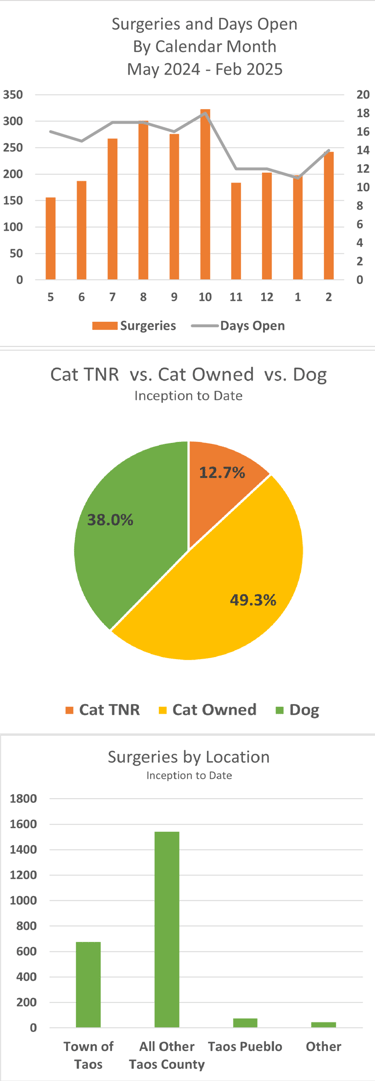
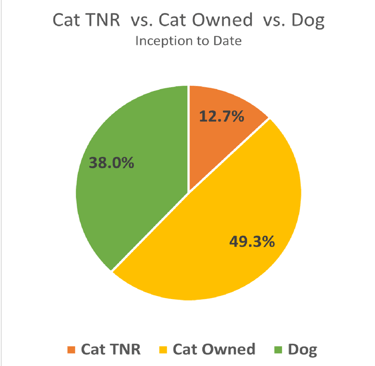
TFFF is pleased to report that its Spay/Neuter Services veterinary clinic in El Prado was open for 148 days and successfully completed 2337 spay/neuter surgeries from the clinic opening date May 2, 2024 through March 1, 2025 when Spay Taos took charge. On an inception-to-date basis, the mix of animals was 297 feral cats, 1151 pet cats and 889 pet dogs. The mix of animals by location was 675 from the Town of Taos; 75 from Taos Pueblo; 1542 from All Other Taos County and 45 from Picuris Pueblo and other counties.
A detailed report analyzing results for each location, animal type and sex is also included. For example, this report shows that overall, 1299 (55.6%) animals were female while 1038 (44.4%) were male.
Leanne Mitchell, President of TFFF, commented, “Excluding our start-up month, TFFF averaged about 242 surgeries per month. On an annual basis, this level of activity approaches 3000 cases per year. At its peak, Stray Hearts averaged about 1300 cases per year counting both the surgeries of shelter residents and the animals transferred out of Taos County. So, our clinic provided and continues to provide through Spay Taos, an intensity of spay/neuter far exceeding anything before in Taos. As a result, I believe Taos has already achieved a substantial reduction in the number of cats and dogs able to reproduce. This, of course, leads to fewer new litters and fewer homeless animals. The cat/dog overpopulation surge that began with the COVID-19 pandemic and worsened when the Stray Hearts/Animal Control contracts ended in 2023 has finally reversed direction.”
Leanne Mitchell, concluded, “With each new spay/neuter, more progress is made, bringing down the homeless population, facilitating the reopening of our community shelter. If you own cats or dogs, please take advantage of the free spay/neuter, life-saving vaccines and micro-chip. If you are feeding feral cats, please remember that only you can stop two or three cats from becoming twenty or thirty. Join the clinic’s Trap, Neuter and Return program and get free traps and free spay/neuter with no appointments needed. The clinic is the foundation of animal welfare in Taos so donate to or volunteer for Spay Taos if you can. At our website (taosferalfelinefriends.org), you can learn more about Taos animal welfare, spay/neuter, and how TFFF helps our community.”
About TFFF: Taos Feral Feline Friends, an all-volunteer charity, has been Taos County’s leading provider of feline spay/neuter and vaccinations for twenty years. In 2024, TFFF opened a full-time, brick and mortar vet clinic in El Prado, NM offering free spay/neuter, vaccinations and micro-chipping for all cats and dogs of Taos County.